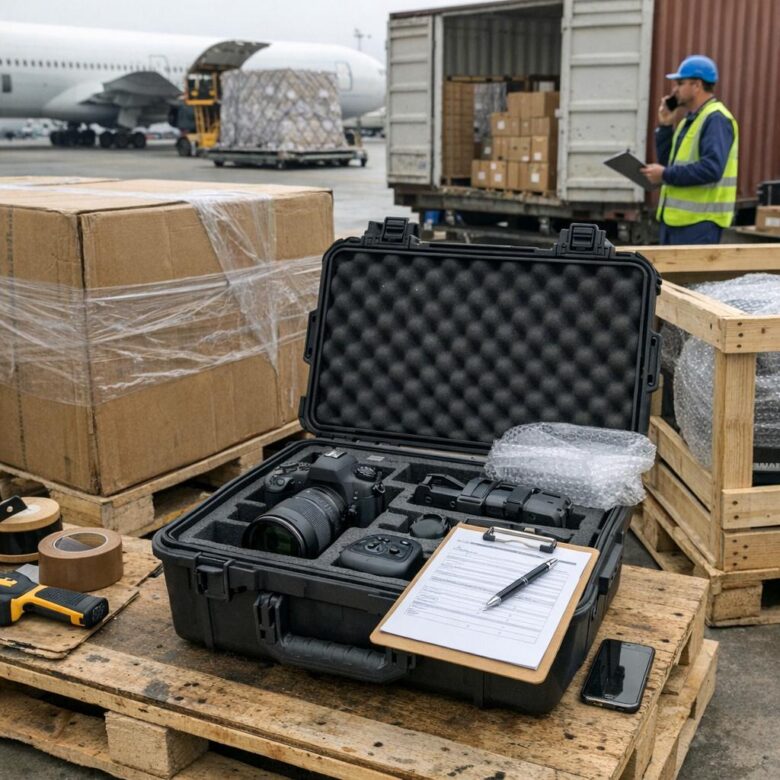
Moving expensive machinery, electronics, laboratory instruments or professional equipment across borders creates more than a shipping risk. A loss can also create replacement delays, installation costs, interrupted projects and difficult disputes between carriers, freight forwarders, sellers and insurers. Effective protection begins before the equipment is packed.
Start with the complete transit chain
A policy is only useful when its geographic and time limits match the real shipment. High-value equipment may pass through several hands before reaching the destination: the shipper, packing company, road carrier, airline or ocean carrier, transshipment terminal, customs warehouse, local delivery company and installation team.
Ask the insurer or broker to confirm the exact point at which coverage begins and ends. Expressions such as “warehouse to warehouse” or “door to door” should not be accepted without checking their definitions, termination provisions and storage limits.
Physical transit
The movement of equipment by road, rail, air, sea or courier, including agreed loading, unloading and transshipment stages.
Incidental storage
Temporary storage that forms part of the insured journey. Long delays, project storage or warehousing after arrival may require separate terms.
Cargo insurance versus carrier liability
Carriers and freight providers may accept contractual responsibility for cargo, but that responsibility can be limited by transport terms, applicable conventions, weight, package count, declared value or the cause of loss.
Cargo insurance is a separate contract designed to protect the insured financial interest in the equipment, subject to its own limits and exclusions. Declaring a high value to a carrier may affect liability or freight charges, but it should not be assumed to create an independent insurance policy.
| Protection | What it generally addresses | Important limitation |
|---|---|---|
| Carrier liability | Legal or contractual responsibility of the carrier for certain losses | May be limited and may require proof that the carrier is legally responsible |
| Declared value | A value communicated to a carrier under its shipping terms | Does not always provide broad cargo insurance or cover every cause of loss |
| Single-shipment cargo policy | One identified movement, route and insured value | Changes to route, storage or equipment may require insurer approval |
| Annual open cargo policy | Multiple qualifying shipments during the policy period | Declarations, territorial limits, conveyance limits and reporting conditions may apply |
| Equipment floater or portable-equipment cover | Mobile equipment used at different locations | International transit, unattended vehicles or ocean freight may be restricted |
| Business interruption cover | Certain financial effects of an insured operational interruption | It may not respond to transit loss unless specifically connected to insured property damage |
Understand Incoterms without assuming they solve everything
Incoterms define important responsibilities between a seller and buyer, including transport tasks, costs, risk transfer, customs formalities and whether one party must arrange cargo insurance. They do not replace the sales contract or automatically provide sufficient insurance for expensive equipment. [1]
Under Incoterms 2020, CIP and CIF are the two rules that place an insurance-arranging obligation on the seller. CIP can be used for multimodal transport and generally requires broader insurance than CIF. CIF is limited to sea or inland-waterway transport and requires a lower minimum level of cover. [2]
| Term | Transport use | Seller’s insurance obligation | Buyer’s practical review |
|---|---|---|---|
| CIP | Any mode or combination of modes | Broader cover based on Institute Cargo Clauses (A) or similar terms | Check limits, exclusions, insured value and where cover terminates |
| CIF | Sea or inland-waterway transport | Minimum cover based on Institute Cargo Clauses (C) or similar terms | Consider arranging additional protection for high-value equipment |
| Other Incoterms | Depends on the selected rule | May not obligate either party to purchase insurance | Allocate insurance responsibility clearly in the sales contract |
Choose a policy structure that matches the equipment
Single-transit policy
Appropriate for an occasional shipment with a defined route, conveyance, value and delivery date. It should be issued before the insured risk begins.
Annual open cargo policy
May be more practical for businesses shipping frequently. Review per-conveyance limits, declarations, excluded countries and maximum storage periods.
Exhibition or demonstration cover
Can address outward transit, temporary use at an event, onsite handling and return transit when those stages are specifically included.
Installation or project cover
May be needed when risk continues after delivery during positioning, assembly, testing, commissioning or installation at the customer’s site.
Leased or borrowed equipment cover
The policy should reflect contractual responsibility, legal ownership and the amount the company would owe if the equipment were lost or damaged.
Specialized delay protection
Projects dependent on critical machinery may need separate delay-in-start-up or similar specialist cover. Ordinary cargo insurance may not pay lost revenue caused only by late arrival.
Build an accurate insured value
The original invoice price may not represent the complete financial exposure. A used machine could cost more to replace quickly than its accounting value, while custom equipment may require engineering, software, calibration and installation before it can operate.
Discuss the valuation basis with the insurer and document it in the policy or certificate. Possible components include:
- Current replacement cost of the equipment
- International freight and handling charges
- Customs duties and non-recoverable taxes
- Professional packing and crating costs
- Software or control-system components
- Calibration and testing expenses
- Installation and commissioning costs
- Expedited replacement freight
- Specialist technician travel where insurable
- Expected price changes during the project
Treat packaging as part of the insurance plan
Cargo insurance does not remove the shipper’s responsibility to prepare equipment for the expected journey. The crate, internal bracing, lifting points, corrosion protection and moisture controls should reflect the equipment’s weight, fragility, route and handling method.
| Equipment type | Main exposure | Possible control |
|---|---|---|
| Precision electronics | Impact, vibration, static electricity and humidity | Anti-static protection, cushioning, vapor barrier, desiccant and impact indicators |
| Heavy machinery | Movement, tipping, lifting damage and structural stress | Engineered base, certified lifting points, blocking, bracing and professional lashing |
| Medical or laboratory equipment | Shock, contamination, temperature variation and calibration loss | Manufacturer packing instructions, sealed protection and post-delivery validation |
| Optical and imaging equipment | Misalignment, vibration, scratches and condensation | Custom foam, lens protection, sealed cases and orientation markings |
| Temperature-sensitive components | Heat, freezing or temperature excursion | Qualified thermal packaging, data logger and documented contingency plan |
| Out-of-gauge cargo | Inadequate securing, exposed surfaces and route restrictions | Route survey, loading plan, specialized carrier and securing calculations |
The International Maritime Organization’s cargo-securing guidance emphasizes that safe stowage and securing depend on proper planning, execution and supervision by qualified personnel. [3]
Check batteries and other regulated components
Equipment containing lithium batteries, fuel, compressed gas, refrigerants, chemicals or magnetized materials may be subject to dangerous-goods requirements. Classification, testing, state of charge, packaging, marking and carrier acceptance can vary by transport mode.
IATA publishes specific guidance for shipping lithium batteries by air, including batteries contained in equipment or packed with equipment. The shipper should use current regulations and manufacturer information rather than relying on an old packing method. [4]
- Identify every battery and regulated component
- Record battery chemistry and watt-hour rating
- Obtain required battery test documentation
- Check whether the battery is damaged or defective
- Use the correct dangerous-goods classification
- Follow current packing and marking instructions
- Confirm carrier and airline acceptance
- Use trained personnel where required
Temporary imports and ATA Carnets
Equipment sent abroad for exhibitions, demonstrations, filming, professional assignments or temporary projects may qualify for an ATA Carnet in participating customs territories. The carnet can simplify temporary import and re-export procedures and may avoid paying import duties and taxes at each border. [5]
An ATA Carnet is a customs document—not cargo insurance. The equipment still needs appropriate protection for physical loss or damage during outward transit, use abroad, temporary storage and return transit.
Carnet users must follow the applicable customs procedures and re-export the goods within the required period. Selling, modifying, consuming or leaving the listed equipment abroad can create customs liabilities.
Review exclusions and special conditions
“All risks” does not mean every possible event is covered. It generally describes a broad form of physical loss or damage protection that remains subject to exclusions, conditions, deductibles and policy limits.
Damage caused by insufficient or unsuitable preparation may be excluded, particularly when packing is controlled by the insured.
Missed deadlines, lost profit and contractual penalties may not be covered by standard cargo insurance.
Deterioration resulting from the nature of the equipment or ordinary use may fall outside transit cover.
Theft protection may depend on alarms, approved parking, locked compounds or other security conditions.
These perils may require separate clauses, territorial approval or additional premium and can be changed or cancelled under policy terms.
Physical damage to hardware does not necessarily cover lost data, corrupted software or cyber-related interruption.
Coverage and claims payment may be restricted when a route, counterparty or destination is affected by sanctions.
A change of vessel, destination, storage period or mode of transport may need to be reported to the insurer.
Use a controlled shipment process
- Identify the equipment and financial exposure Record ownership, serial numbers, condition, replacement cost, project dependency and contractual responsibilities.
- Map the complete route Include collection, warehouses, transshipment points, customs facilities, destination storage and return transit when applicable.
- Choose the correct transport and Incoterm Confirm who bears risk at each stage and who is responsible for arranging insurance.
- Obtain insurance before the risk begins Provide accurate equipment, route, packing, value and dangerous-goods information to the insurer.
- Approve professional packing Use written specifications appropriate to weight, fragility, climate, lifting and transport mode.
- Create a pre-shipment condition record Photograph the equipment and packaging, record serial numbers and document operational condition.
- Control carrier handoffs Require signatures, seal records, tracking milestones and exceptions for visible damage or missing packages.
- Inspect immediately at destination Check external packaging before signing a clean delivery receipt and document concealed damage during unpacking.
- Retain the shipment file Store the policy, invoice, packing list, transport documents, photos, tracking records and delivery evidence together.
What to do when damage or loss is discovered
Claim procedures and notice periods vary. Follow the policy and transport documents immediately rather than waiting for repair estimates or an internal investigation to finish.
- Take reasonable steps to prevent further damage
- Record exceptions on the delivery receipt
- Photograph the crate before moving or opening it
- Photograph the equipment and every damaged area
- Preserve packaging, seals and impact indicators
- Notify the insurer or broker promptly
- Notify potentially responsible carriers in writing
- Request a surveyor when instructed
- Separate damaged and undamaged components
- Obtain repair and replacement quotations
- Keep customs, freight and storage records
- Avoid disposal without insurer approval
Pre-shipment insurance checklist
- Legal owner and insured interest are identified
- Equipment description and serial numbers are accurate
- Replacement value has supporting evidence
- Freight, duties and additional costs are addressed
- Route and every planned storage location are disclosed
- Incoterm and risk-transfer point are documented
- Carrier liability has been reviewed separately
- Policy begins before collection or loading
- Loading and unloading are addressed
- Temporary storage limits are acceptable
- Return transit is included when needed
- Used-equipment terms are understood
- Battery and dangerous-goods rules are satisfied
- Packaging requirements are documented
- Theft security conditions are understood
- War, strikes and political risks are reviewed
- Claim contacts and deadlines are available
- All documents are stored in one shipment file
Frequently asked questions
Does freight insurance cover the equipment’s full replacement value?
Not automatically. Carrier liability, declared value and cargo insurance have different rules. The policy must state an appropriate insured value and valuation basis, subject to its limits and exclusions.
What does all-risk cargo insurance mean?
It generally refers to broad physical loss or damage coverage rather than a policy covering every imaginable event. Exclusions, conditions, deductibles and territorial limits still apply.
Does cargo insurance cover customs delays?
It may protect equipment against certain insured physical risks during qualifying customs storage, but delay costs, penalties and lost revenue are often treated separately. Review the policy wording.
Can used business equipment be insured?
It may be insurable, but the insurer may request condition reports, recent photographs, maintenance information or an agreed valuation. Existing damage and ordinary wear should be documented before shipment.
Is an ATA Carnet a form of equipment insurance?
No. It is an international customs document for qualifying temporary imports and exports. Separate insurance is needed for physical loss, damage and other insured risks.
Who should arrange insurance under Incoterms?
It depends on the agreed Incoterm. CIP and CIF include an insurance obligation for the seller, while other rules may not require either party to purchase insurance. The parties can also negotiate additional contractual protection.
Are loading and unloading automatically covered?
Not necessarily. Coverage depends on when the insured transit begins and ends and whether loading, unloading, positioning or installation falls within the policy definition.
Does insurance cover lost software or data?
Standard cargo insurance primarily addresses physical property loss or damage. Software reconstruction, data loss, cyber events and licensing costs may require specific coverage.
Should the company use a broker for one expensive shipment?
Specialist assistance may be useful when equipment is unusually valuable, fragile, hazardous, leased, used, difficult to replace or essential to a project. The company should still review the final policy documents itself.
Final perspective
Protecting high-value equipment during international transit requires more than purchasing insurance at the freight-booking screen. The company must align ownership, valuation, packaging, transport responsibilities, customs documents, storage and claim procedures.
The strongest arrangement is built around the real journey and financial consequence of loss. Coverage should be confirmed before collection, unusual risks should be disclosed in writing and evidence should be created while the equipment is still in good condition.
Official sources and further reading
- International Trade Administration — Know Your Incoterms
- ICC Academy — Incoterms 2020: CIP or CIF?
- International Maritime Organization — Code of Safe Practice for Cargo Stowage and Securing
- International Air Transport Association — Lithium Battery Transport Guidance
- International Chamber of Commerce — ATA Carnet
- International Trade Administration — ATA Carnet for Temporary Shipments
- Lloyd’s Market Association — Joint Cargo Committee

Lasarga Editorial Team researches and reviews educational content on international personal finance, cross-border property, expatriate tax topics, global mobility and executive travel. The team prioritizes primary sources, clear limitations and practical explanations for an international audience.